High Noon Duel game info: every figure with the source attached
This page is the reference table, and it is organised by where each figure came from rather than by what it is about. Three levels are used throughout the site. A figure read off a recorded screen of the game itself is the strongest thing here and belongs to this site. A figure stated by the earlier build of this domain, which was written from those same screens, is ours too but one step removed. A figure that only an outside write-up carries is named as theirs.
The reason for being that pedantic is on the second half of this page. One figure a reader will certainly come looking for does not survive the test, and saying so is more useful than filling the gap.
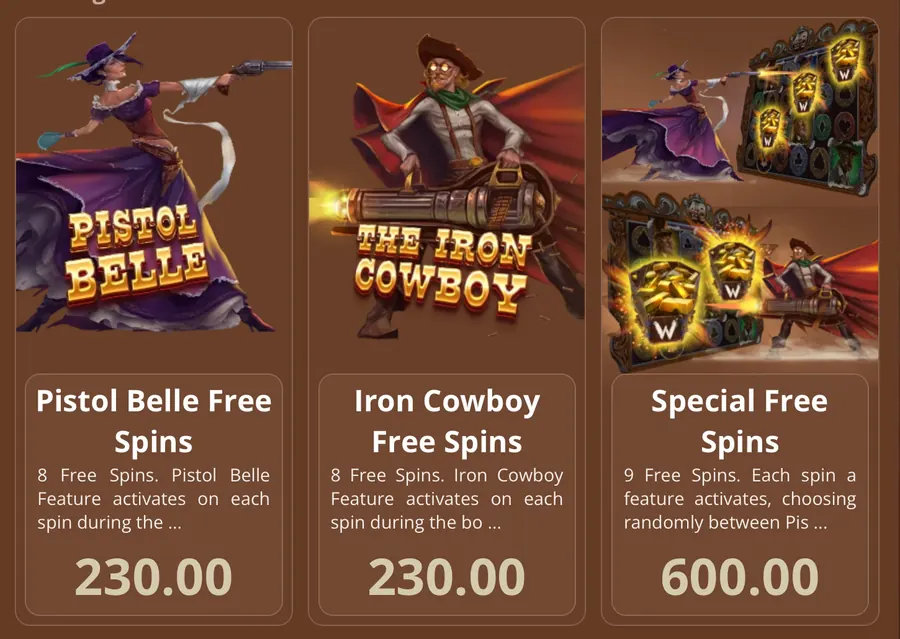 The three bonus formats as the game prints them, with eight spins on each character card, nine on the Special card, and the prices that correspond to the stake set below the panel.
Attributes
Twenty-four positions, and why the count matters
Six columns and four rows give twenty-four positions in view. On a board with drawn lines that number would be trivia; here it is the whole arithmetic, because every position is a candidate for every combination. A symbol in the bottom row of reel one and a matching symbol in the top row of reel two form the first two links of a chain exactly as readily as two sitting side by side would.
It also sets the scale of the two wild shapes. A square block covers four of those twenty-four positions at once — a sixth of the board in a single stamp — while a scattered handful covers fewer but can reach parts of the grid a square never would.
Why no return figure appears on these pages
The earlier build of this domain answered the question with a flat no, and that answer is kept. What has changed is that the reason can now be given properly rather than left as a refusal.
Our own material on High Noon Duel — the recorded screens and everything written from them — contains no return figure at all. The panels that were captured are the bonus selection screen, the board and the feature art, none of which carries one. So this site has nothing of its own to print.
Outside material does carry a figure, and that is where it becomes interesting rather than simply empty. Two independent write-ups state one. They do not, however, agree that it is a single number: one of them marks this title as having a range rather than a fixed value, and the other gives a base-game figure and then separate figures for the three bought bonus entries. A game whose own commentators describe the number differently from one another is not a game where one percentage can be printed as fact, and the rules this site is written under forbid promoting an outside figure to a confirmed one.
So the position is this, in three parts. There is no figure here that this site can stand behind. There is at least one figure in circulation elsewhere, so a reader who goes looking will find something. And what is in circulation is not one number but a base value with variations attached to it, which means a reader who finds a single percentage quoted somewhere has probably met one step of a ladder rather than the answer. Where the number matters, the place to read it is the information panel of the game itself at the operator you are playing at.
What a catalogue adds, and what is left out of this table
Outside listings for this title also carry a bet range, a count of ways to win and a hit frequency. Those are not in the table above, and the omission is deliberate rather than an oversight. Nothing on this site confirms them: the recorded screens show a single stake in use and the game's own help pages were not captured. They are therefore somebody else's figures about a product we can describe but not measure, and a reference table that mixes the two is worth less than one that does not.
The same test is why volatility and the release month appear in the table but are marked as outside statements. Two independent sources carry each, they do not contradict each other, and neither is a number a reader could lose money by trusting. A return percentage fails that last part, which is why it is treated differently.
Nothing on this page is a rating
There is no score out of ten here, no star count and no verdict dressed as data. Nobody on this site has played a measured session of High Noon Duel, so there is nothing a rating could honestly be built out of, and a rating invented for a page about money is worse than no page at all. What the table holds is the board, the rules, the counts and the ceiling, each with the source that supports it.
Questions about the figures
- Is a return percentage listed on this site?
- No. Our own record of the game carries none, and the outside sources that do carry one do not agree that it is a single number, so no figure is printed here.
- Does that mean the figure is being hidden?
- No. It means this site has nothing it can stand behind, which is a different thing from a number that exists and is being withheld.
- How many positions are on the board?
- Twenty-four: six reels by four rows, all of them in view at once.
- Which name belongs in the studio field?
- Elysium Studios wrote the game. Swintt owns Elysium Studios and ships it, so both names are correct and this site uses each where it applies.
- What does the bonus panel show at the stake in the picture?
- Either character format at 230.00 and the Special format at 600.00, against a stake of 2.00.