High Noon Duel features: how one paid spin turns into several
Strip the Western dressing away and this game runs on three rules that interlock. Wins are counted across touching reels rather than along drawn lines. Winning symbols leave the board instead of staying on it. And a multiplier climbs with every link in that chain — but only keeps what it has climbed when a bonus is running.
Each of the three is ordinary on its own. Together they decide why the wilds take the shapes they do and why the bonus formats are worth more than their spin counts suggest.
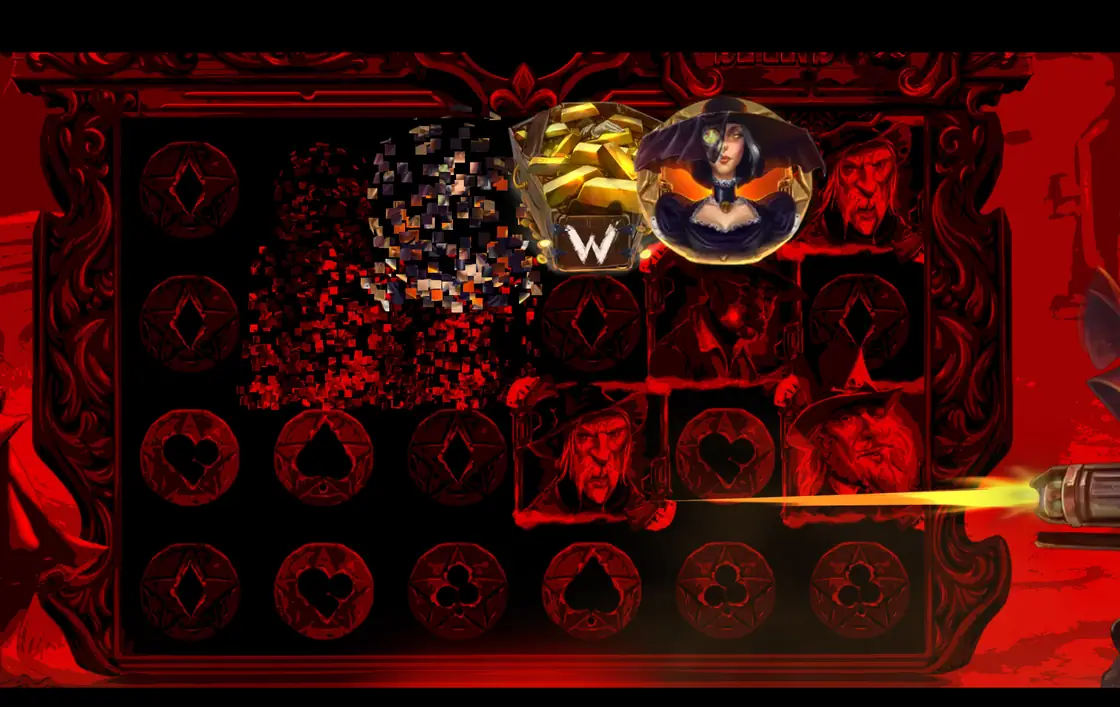 A round resolving on a recorded screen. Symbols at the top left are mid-break after a win, a gold wild chest has taken a position beside them, and the Cowboy's shot runs across the lower rows.
The three rules
Gameplay and mechanics
A six-reel board with no drawn lines changes what a player is actually looking at. On a line game the eye follows a shape; here it counts columns. Three matching gunfighters on reels one, two and three pay whether they sit top, middle or bottom, and a fourth on reel four extends the same combination. Break the chain — nothing matching on reel two — and reels three to six are irrelevant no matter what they hold.
That rule has a consequence worth stating plainly, because it is the opposite of what a line game teaches. The leftmost reel is the gatekeeper for everything. A board that looks crowded with high symbols can be worth nothing at all if the first column has none of them, and a board that looks sparse can pay if the few it has are stacked in the right columns.
Each paid sequence can refill the open spaces
When a combination is found, the symbols that made it are removed and new ones fall in. The board then re-reads itself. If the new arrangement contains another valid chain, it pays and clears as well, and the process repeats until a refill produces nothing. One purchase of a spin can therefore resolve two, three or more times.
This is the mechanism the whole design is built around, and it explains a choice that would otherwise look arbitrary: why the wilds in this game come in such different shapes. A scattered handful of wilds helps several separate chains at once. A solid square helps one chain enormously, by bridging two columns and two rows at the same time. A straight run of converted positions helps a chain that was one reel short. Three answers to the same question, which is how to keep a tumble going for one more step.
Where the multiplier carries and where it does not
Each link in a chain raises a multiplier applied to what the chain pays. The trade report that covered the release is specific about the limit on that: in base play the figure resets at the start of every new paid spin, and in any of the free spins formats it does not reset at all until the format ends. That is attributed because it is their statement — our own recorded screens show a multiplier climbing but cannot show what it does across a boundary.
If the statement is right, it accounts for the distance between an ordinary round here and a very large one. Eight spins that each chain two or three times, with the figure carried across all of them, compound in a way that eight independent spins never could. It is also why a stated ceiling of 27,000x on a game with no drawn lines is not as strange as it first looks.
Buying in, and what it changes
The game's own panel offers five paid entries rather than the three a reader would expect. Alongside the three bonus formats sit Bet Boost and Super Bet Boost, which do not buy a round at all: they raise the active bet and improve the chance that a bonus arrives on its own, by about double in the first case and around twenty-two fold in the second. At the 2.00 stake on the recorded panel they are priced at 2.80 and 20.00, against 230.00 for either character format and 600.00 for the Special one.
Two qualifications go with that, both from the trade report that covered the release rather than from here. Wins under either boost are still worked out on the original base bet, not on the raised one. And whether the bought entries are offered at all depends on the jurisdiction the account sits in, so a reader in Great Britain may find the panel shorter than the one in the picture on this page.
Questions about how the game plays
- How is a win formed on this board?
- Matching symbols pay when they sit on reels that touch, counted from the leftmost reel rightwards, whatever row each one is in.
- What is a tumble?
- The symbols that formed a win are removed and the gaps they leave are filled from above, so one paid spin can resolve several times.
- Does the multiplier survive a new spin?
- In base play it starts again each time the reels turn. Inside a bonus the trade report says it keeps climbing for the whole round.
- Are there drawn paylines to study?
- No. Nothing on this board is a fixed line, so there is no line map to learn and no bet-per-line arithmetic to do.